Programmes
What will your child experience at dMP?
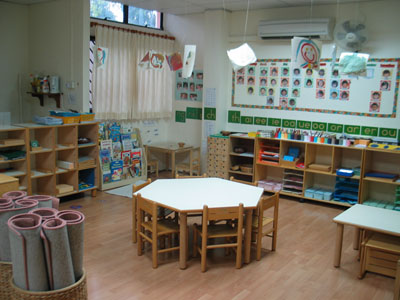
A morning at dMP brings together hands-on Montessori work, group lessons and opportunities to explore the world around us.
Our mixed-age classroom allows children to learn alongside classmates at different stages of development. Each child is supported according to their readiness, rather than expected to follow exactly the same pace as everyone else.
Which programme is right for your child?
Pre-Nursery (PN) and Nursery (N)
The early years are full of discoveries. Children are learning to do more for themselves, communicate their needs and make sense of the world around them.
Our programme offers hands-on Montessori activities, English and Chinese language experiences, practical life skills, early mathematical concepts and opportunities to explore through stories, music, movement and group activities.
Children are introduced to activities gradually and given time to practise as their confidence grows.
Kindergarten 1 (K1) and Kindergarten 2 (K2)
As children grow, their Montessori work develops in complexity. They build on earlier experiences, strengthen their language and mathematical understanding and explore a wider range of cultural topics.
Our daily Montessori Phonics and Mathematics programmes provide regular opportunities to develop these foundations. Children also take part in cultural studies, creative activities, music and movement, Chinese language lessons and other shared experiences.
The optional Extended Hours Programme provides additional time for enrolled Kindergarten 1 (K1) and Kindergarten 2 (K2) children. Please call us at 6388 4033 for more details.
What does a typical morning look like?
Our regular programme runs from 8:30am to 12:00pm.
The morning Montessori work period takes place from 8:30am to 10:30am, beginning with group lessons before children move on to individual Montessori work.
The rest of the morning includes other planned learning experiences, giving children opportunities to learn together, explore independently and participate in activities with their classmates.
What can children explore in our classroom?
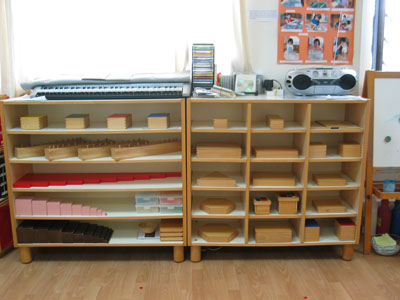
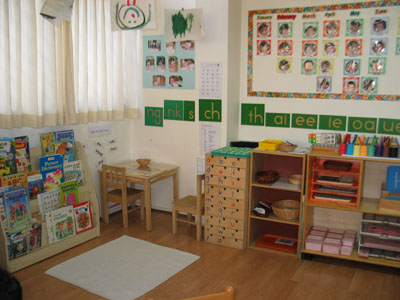
Our classroom is organised into five main areas. The materials are carefully selected and introduced according to what the children are ready to learn. (For the ideas behind each area, see Our Philosophy.)
Practical Life
From pouring and transferring activities to dressing frames, children practise the everyday movements that help them become more independent.
Our materials include 11 dressing frames featuring zips, buttons, laces, buckles, hooks and eyes, and Velcro, as well as practical washing activities.
Sensorial
Children explore and compare qualities such as size, shape, colour and sound using classic Montessori materials.
These include the Pink Tower, Broad Stair, Knobless Cylinders, Geometry Cabinet, Colour Tablets and Sound Boxes.
English Language
Children develop their listening, speaking, reading and writing foundations through a rich language environment.
Materials include Sandpaper Letters, Movable and Printed Alphabets, Metal Insets, phonics boxes and graded reading folders.
Mathematics
Children explore number and quantity using concrete materials before progressing towards more abstract mathematical ideas.
Our materials include the Montessori decimal system, bead chains, Seguin boards and resources for addition, subtraction, multiplication and division.
Cultural Studies
Children discover the natural and wider world through geography, botany, zoology, history and science.
Materials include the Botany Cabinet, globes, land-and-water forms and a puzzle map of the world.
What else is there to discover?
Our Book Corner is refreshed fortnightly to encourage children to discover new stories and topics. We also include selected resources from World Book's Early World of Learning series.
What happens beyond individual Montessori work?
Learning also happens when children come together to listen, talk, create, investigate and share ideas. Our group activities include:
- Chinese language: Opportunities to develop familiarity with the Chinese language through lessons and activities.
- Cultural studies: Discussions and projects covering history, science, botany, zoology and geography.
- Creative experiences: Art, cookery, music and movement.
- Character-building activities: Learning to care for others, take responsibility and participate as part of a community.
- Sound of the Week: Regular exploration of English speech sounds, covering 40 of the 44 speech sounds in English.
- Thematic Mathematics: Group experiences that complement our Montessori mathematics programme, using curriculum resources from Montessori Centre International.
Where else do children learn?
The world outside our classroom offers many opportunities to learn. Throughout the year, children may take part in:
- Field trips to farms and places of interest.
- Neighbourhood walks to observe the local environment.
- Outdoor activities at Punggol Park.
- Playground Weeks, when children have additional opportunities for playground play without a scheduled large-group gross-motor activity.
These experiences help children connect what they learn in school with the world around them.